
BPR
BPR 算法
显式反馈:用户对物品的评分,如电影评分;隐式反馈:用户对物品的交互行为,如浏览,购买等,现实中绝大部分数据属于隐式反馈,可以从日志中获取。BPR是基于用户的隐式反馈,为用户提供物品的推荐,并且是直接对排序进行优化。贝叶斯个性化排序(Bayesian personalized ranking,BPR)是一种 Pairwise 方法,并且借鉴了矩阵分解的思路。在开始深入讲解原理之前我们先了解整个 BPR 的基础假设以及基本设定。
因为是基于贝叶斯的 Pairwise 方法,BPR 有两个基本假设:
- 每个用户之间的偏好行为相互独立,即用户 u 在商品 i 和 j 之间的偏好和其他用户无关。
- 同一用户对不同物品的偏序相互独立,也就是用户 u 在商品 i 和 j 之间的偏好和其他的商品无关。
这里补充一下Pairwise。配对法(Pairwise)的基本思路是对样本进行两两比较,构建偏序文档对,从比较中学习排序,因为对于一个查询关键字来说,最重要的其实不是针对某一个文档的相关性是否估计得准确,而是要能够正确估计一组文档之间的 “相对关系”。
因此,Pairwise 的训练集样本从每一个 “关键字文档对” 变成了 “关键字文档文档配对”。也就是说,每一个数据样本其实是一个比较关系,当前一个文档比后一个文档相关排序更靠前的话,就是正例,否则便是负例,如下图。试想,有三个文档:A、B 和 C。完美的排序是 “B>C>A”。我们希望通过学习两两关系 “B>C”、“B>A” 和 “C>A” 来重构 “B>C>A”。
BPR 用来解决隐式反馈的推荐排序问题,假设有用户集 U 和物品集 I,当用户 u(u∈U)在物品展示页面点击了物品 i(i∈I)却没有点击同样曝光在展示页面的物品 j(j∈I),则说明对于物品 i 和物品 j,用户 u 可能更加偏好物品 i,用 Pairwise 的思想则是物品 i 的排序要比物品 j 的排序更靠前,这个偏序关系可以写成一个三元组 <u,i,j>,为了简化表述,我们用 >u 符号表示用户 u 的偏好,<u,i,j> 可以表示为:i>uj。单独用 >u 代表用户 u 对应的所有商品中两两偏序关系,可知 >u⊂.
记 S 为所有用户对所有物品发生的隐式反馈集合,这里针对隐式反馈问题对评分矩阵进行了简化,即点击过则视为正例,记为 1;没点击过则视为负例,通常会置为 0,如下图所示:
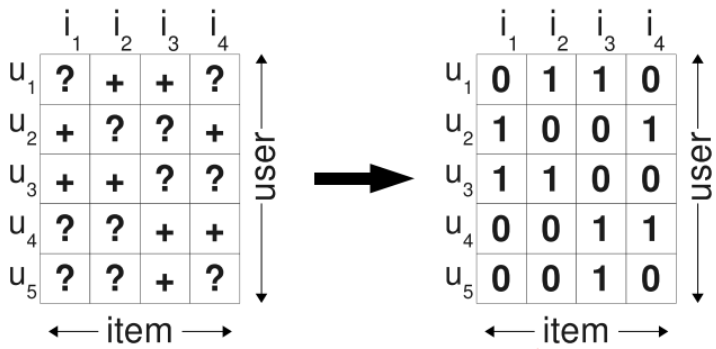 .
.
BPR 试图通过用户的反馈矩阵 S 来为每一个用户构建出完整的偏序关系,也称全序关系,用 >u 表示.如下图所示:
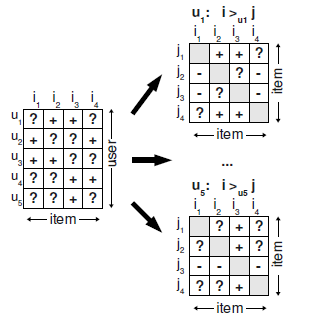
图左边的矩阵是反馈数据集 S,“+” 代表有反馈数据,“?” 代表无反馈数据。
图右边的小矩阵是每个用户的偏序关系矩阵,“+” 代表用户喜欢 i 胜过喜欢 j,作为训练数据的正例;“-” 代表用户喜欢 j 胜过喜欢 i,作为训练数据的负例;“?” 代表同类数据无法确定偏序关系。
比如用户 u1 看过产品 i2 但是没看过产品 i1,所以我们假设用户喜欢产品 i2 胜过 i1:即 i2>ui1。对于用户均产生反馈过的产品,我们不能推断出任何偏好,同样,对于那些用户都没有反馈过的两个产品,我们也不能推断出任何偏好。也就是说,两个有反馈数据之间以及两个无反馈数据之间都无法构建偏序关系。
为了形式化描述这种情形,我们定义训练数据 DS:U×I×I :
其中 (u,i,j)∈DS 的表示是用户 u 更喜欢 i 胜过 j;∧ 是离散数学中的符号,表示 and,等同于 ∩; 表示物品集 I 除正例外其他剩余的样本。
BPR 模型本质是一种矩阵分解算法,所以其模型本质上是为了将用户物品矩阵分解成两个低维矩阵(用户矩阵()和物品矩阵()),在由两个低维矩阵相乘后得到完整的矩阵。即
对于任意一个用户u,对应任意一个物品i我们期望有:
我们的目的就是找到合适的矩阵W,H让和X最相似。
BPR损失函数
BPR 基于最大后验估计P(W,H|>u)来求解模型参数W,H,这里我们用θ来表示参数W和H, >u代表用户u对应的所有商品的全序关系,则优化目标是P(θ|>u)。根据贝叶斯公式,我们有:
由于我们假设了用户的排序和其他用户无关,那么对于任意一个用户u来说,P(>u)对所有的物品一样,所以有:
这个优化目标转化为两部分。第一部分和样本数据集D有关,第二部分和样本数据集D无关。
对于第一部分,由于我们假设每个用户之间的偏好行为相互独立,同一用户对不同物品的偏序相互独立,所以有:
其中,
根据上面讲到的完整性和反对称性,优化目标的第一部分可以简化为:
而对于这个概率,我们可以使用下面这个式子来代替:
对于,我们要满足当时,,当时,,所以有
最终,我们的第一部分优化目标转化为:
对于第二部分P(θ),原作者大胆使用了贝叶斯假设,即这个概率分布符合正太分布,且对应的均值是0,协方差矩阵是,即
对于上面假设的这个多维正态分布,其对数和成正比。即
最终对于我们的最大对数后验估计函数
这里给出另外一种推导方法:原博客地址
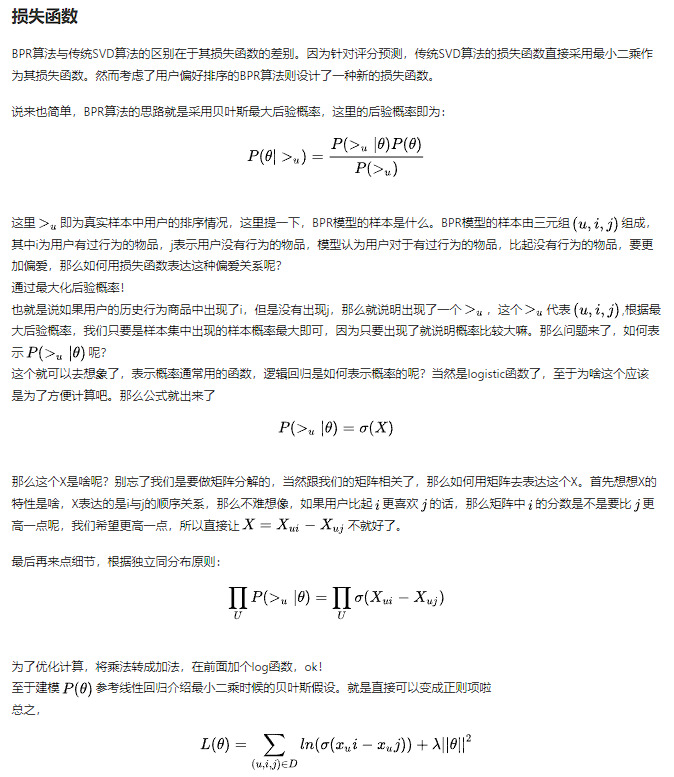
接着使用梯度下降法来优化参数模型即可。
由于
所以
Pytorch 实现
#####导包
1 | import numpy as np |
数据处理
此数据集中UserID 0~4039 MovieID 0~3075
train.rating中一共994169行
train_mat (6040,3706)
test_data 604000
1 | dataset = 'ml-1m' |
1 | # 1、训练集 |
        user  item
0          0    32
1          0    34
2          0     4
3          0    35
4          0    30
...      ...   ...
994164  6039  1092
994165  6039    41
994166  6039   128
994167  6039   323
994168  6039   669

[994169 rows x 2 columns]
6039
6040 3706
1 | train_data1 = pd.read_csv(train_rating, sep='\t', header=None, names=['user', 'item'], |
1 | index=train_data1[(train_data1.user==745)&(train_data1['item']==510)].index.tolist() |
| user | item | |
|---|---|---|
| 114281 | 745 | 510 |
1 | (train_data[:10]) |
[[0, 32],
 [0, 34],
 [0, 4],
 [0, 35],
 [0, 30],
 [0, 29],
 [0, 33],
 [0, 40],
 [0, 10],
 [0, 16]]
1 | # 2、训练样本转换为稀疏矩阵 |
1 | #print(train_mat) |
<6040x3706 sparse matrix of type '<class 'numpy.float32'>'
	with 994169 stored elements in Dictionary Of Keys format>
1 | # 3、测试集数据读取,即为每个用户赋值99个没评分过的item。 1个评分过的+99个未评分的。 |
1 | test_data |
1 | # 根据继承pytorch的Dataset类定义BPR数据类 |
1 | #生产datalodaer |
1 | train_loader.dataset.ng_sample() |
tensor([2276, 4534, 2665, ..., 5975, 720, 5452]) tensor([ 733, 385, 517, ..., 714, 2270, 60]) tensor([ 800, 2328, 641, ..., 3351, 2708, 3218])
1 | x.shape |
torch.Size([4096])
1 | train_loader |
<torch.utils.data.dataloader.DataLoader at 0x7f4c6bfbbb80>
模型
1 | #定义模型 |
1 | #定义训练设备 |
device(type='cpu')
1 | model=BPR(user_num,item_num,32) |
BPR(
  (embed_user): Embedding(6040, 32)
  (embed_item): Embedding(3706, 32)
)
1 | for i in model.children(): |
Embedding(6040, 32)
=================================
Embedding(3706, 32)
=================================
1 | prediction_i,prediction_j=model(x,y,z) |
tensor([-5.4056e-05, -2.6378e-04, -3.0876e-04,  2.2027e-04,  6.8639e-04,
         1.4840e-04,  6.5324e-04,  2.3459e-05, -6.2787e-04,  1.3832e-04],
       grad_fn=<SliceBackward0>)
1 | prediction_j[:10] |
tensor([ 0.0009,  0.0002,  0.0006, -0.0001,  0.0008, -0.0005, -0.0004,  0.0001,
        -0.0001, -0.0004], grad_fn=<SliceBackward0>)
1 | #定义优化器 |
评价指标
1 | #定义评价指标 |
训练
1 | #开始训练 |
The time elapse of epoch 000 is: 00: 00: 35
HR: 0.442	NDCG: 0.247
The time elapse of epoch 001 is: 00: 00: 32
HR: 0.454	NDCG: 0.254
The time elapse of epoch 002 is: 00: 00: 31
HR: 0.487	NDCG: 0.272
The time elapse of epoch 003 is: 00: 00: 34
HR: 0.522	NDCG: 0.292
The time elapse of epoch 004 is: 00: 00: 30
HR: 0.558	NDCG: 0.314
The time elapse of epoch 005 is: 00: 00: 31
HR: 0.585	NDCG: 0.329
The time elapse of epoch 006 is: 00: 00: 30
HR: 0.602	NDCG: 0.342
The time elapse of epoch 007 is: 00: 00: 34
HR: 0.617	NDCG: 0.354
The time elapse of epoch 008 is: 00: 00: 33
HR: 0.629	NDCG: 0.363
The time elapse of epoch 009 is: 00: 00: 31
HR: 0.641	NDCG: 0.371
The time elapse of epoch 010 is: 00: 00: 29
HR: 0.646	NDCG: 0.377
The time elapse of epoch 011 is: 00: 00: 30
HR: 0.655	NDCG: 0.381
The time elapse of epoch 012 is: 00: 00: 31
HR: 0.660	NDCG: 0.387
The time elapse of epoch 013 is: 00: 00: 30
HR: 0.669	NDCG: 0.392
The time elapse of epoch 014 is: 00: 00: 46
HR: 0.672	NDCG: 0.395
The time elapse of epoch 015 is: 00: 00: 49
HR: 0.682	NDCG: 0.400
The time elapse of epoch 016 is: 00: 00: 57
HR: 0.682	NDCG: 0.401
The time elapse of epoch 017 is: 00: 00: 57
HR: 0.685	NDCG: 0.403
The time elapse of epoch 018 is: 00: 00: 49
HR: 0.689	NDCG: 0.407
The time elapse of epoch 019 is: 00: 00: 36
HR: 0.693	NDCG: 0.408
The time elapse of epoch 020 is: 00: 00: 37
HR: 0.695	NDCG: 0.412
The time elapse of epoch 021 is: 00: 00: 37
HR: 0.689	NDCG: 0.409
The time elapse of epoch 022 is: 00: 00: 39
HR: 0.689	NDCG: 0.410
The time elapse of epoch 023 is: 00: 00: 52
HR: 0.692	NDCG: 0.411
The time elapse of epoch 024 is: 00: 00: 37
HR: 0.695	NDCG: 0.413
The time elapse of epoch 025 is: 00: 00: 38
HR: 0.692	NDCG: 0.413
The time elapse of epoch 026 is: 00: 00: 40
HR: 0.695	NDCG: 0.415
The time elapse of epoch 027 is: 00: 00: 36
HR: 0.695	NDCG: 0.415
The time elapse of epoch 028 is: 00: 00: 36
HR: 0.694	NDCG: 0.415
The time elapse of epoch 029 is: 00: 00: 37
HR: 0.693	NDCG: 0.415
The time elapse of epoch 030 is: 00: 00: 41
HR: 0.692	NDCG: 0.416
The time elapse of epoch 031 is: 00: 00: 40
HR: 0.694	NDCG: 0.415
The time elapse of epoch 032 is: 00: 00: 53
HR: 0.695	NDCG: 0.417
The time elapse of epoch 033 is: 00: 00: 38
HR: 0.690	NDCG: 0.416
The time elapse of epoch 034 is: 00: 00: 50
HR: 0.692	NDCG: 0.415
The time elapse of epoch 035 is: 00: 00: 37
HR: 0.694	NDCG: 0.418
The time elapse of epoch 036 is: 00: 00: 40
HR: 0.696	NDCG: 0.419
The time elapse of epoch 037 is: 00: 00: 47
HR: 0.695	NDCG: 0.417
The time elapse of epoch 038 is: 00: 00: 35
HR: 0.694	NDCG: 0.418
The time elapse of epoch 039 is: 00: 00: 36
HR: 0.697	NDCG: 0.418
The time elapse of epoch 040 is: 00: 00: 35
HR: 0.695	NDCG: 0.417
The time elapse of epoch 041 is: 00: 00: 38
HR: 0.700	NDCG: 0.419
The time elapse of epoch 042 is: 00: 00: 35
HR: 0.696	NDCG: 0.418
The time elapse of epoch 043 is: 00: 00: 36
HR: 0.695	NDCG: 0.419
The time elapse of epoch 044 is: 00: 00: 40
HR: 0.695	NDCG: 0.419
The time elapse of epoch 045 is: 00: 00: 38
HR: 0.697	NDCG: 0.419
The time elapse of epoch 046 is: 00: 00: 38
HR: 0.698	NDCG: 0.420
The time elapse of epoch 047 is: 00: 00: 35
HR: 0.696	NDCG: 0.420
The time elapse of epoch 048 is: 00: 00: 46
HR: 0.697	NDCG: 0.421
The time elapse of epoch 049 is: 00: 00: 36
HR: 0.695	NDCG: 0.419
End. Best epoch 041: HR = 0.700, NDCG = 0.419
1 | for name,parameters in model.named_parameters(): |
embed_user.weight : torch.Size([6040, 32])
embed_item.weight : torch.Size([3706, 32])
1 | a=torch.matmul(model.embed_user.weight,model.embed_item.weight.T) |
1 | a[0,:40] |
tensor([4.9071, 4.6473, 5.6308, 5.1331, 6.1614, 6.1326, 2.8788, 4.9688, 6.9159,
        7.4584, 8.5438, 3.7592, 5.3239, 4.8175, 5.9285, 3.8425, 5.8040, 6.5299,
        4.9970, 4.5068, 4.5942, 4.9868, 5.0015, 6.5845, 2.7117, 5.0826, 6.9670,
        6.3097, 3.1966, 4.6815, 5.9241, 4.2387, 3.9802, 7.7144, 6.6067, 5.3365,
        1.4831, 6.9389, 6.3249, 6.4433], grad_fn=<SliceBackward0>)
1 | prediction_i,prediction_j=model(x,y,z) |
tensor([6.0894, 8.3161, 6.1518, 6.7113, 4.8280, 5.5475, 3.4280, 3.7698, 4.4137,
        4.7349], grad_fn=<SliceBackward0>)
1 | prediction_j[:10] |
tensor([ 3.9372, -1.5270,  1.1126,  0.4262, -2.4253, -2.1125, -0.4545,  0.1158,
         1.9420,  1.9289], grad_fn=<SliceBackward0>)
参考代码
参考代码仓库:https://github.com/guoyang9/BPR-pytorch
Pytorch-BPR
Note that I use the two sub datasets provided by Xiangnan’s repo. Another pytorch NCF implementaion can be found at this repo.
I utilized a factor number 32, and posted the results in the NCF paper and this implementation here. Since there is no specific numbers in their paper, I found this implementation achieved a better performance than the original curve. Moreover, the batch_size is not very sensitive with the final model performance.
| Models | MovieLens HR@10 | MovieLens NDCG@10 | Pinterest HR@10 | Pinterest NDCG@10 |
|---|---|---|---|---|
| pytorch-BPR | 0.700 | 0.418 | 0.877 | 0.551 |